
My 50 Pence on Future Soldier
- Assorted UK Defence Blog

- Jan 10, 2022
- 8 min read
Updated: Jul 23, 2023
In November of last year, the British Army brought out its latest attempt at restructuring, entitled "Future Soldier". The initial idea as I understand it was to create a more mobile and expeditionary force, meeting the needs of the Integrated Review, published again in March last year, which will deserve an article in itself. However, this restructuring came under more scrutiny due to the failure of both Army 2020 as well as Army 2020 Refine. These two both failed primarily due to being too expensive, and not reaching target dates.

As this is quite a large topic to cover, I will split this article into separate sections, discussing each of the main talking points of the review.
Contents:
Introduction
Ranger Regiment
Brigade Combat Teams (BCTs)
3rd (UK) Division
1st (UK) Division
Global Response Force
BATUS
Conclusion
Ranger Regiment:
First, let me address the elephant in the room; I do not believe the Army purposefully gave the Rangers a questionable Cap Badge. Although I do see the similarities, I think it is rather cynical to think that this was done maliciously by the Army. However, at the same time I do believe the decision to be misjudged, and the way British Army and MOD social media teams handled the accusations were not brilliant.

Nonetheless, I believe the social media storm on Twitter and such have spoiled what I believe to be, in principle a very good idea. As the world moves ever closer to a 2nd Cold War-style global environment more conflicts between East and West will be between smaller nations backed by these powers. Thus, if the UK is to engage in these conflicts, without a direct intervention, which is both costly in equipment and possibly lives, the UK must look for a grey-zone, force-training role. This is a tried and tested technique, from the 11th Security Force Assistance Brigade and the use of British forces in Afghanistan post-Herrick, from its early beginnings with the SAS in Oman during the 70s.
So, a semi-special force operating in the grey-zone with the ability to think for itself, whilst partnering with allied forces is a good idea, in principle in least. However, the actual deployment and creation of the Ranger Regiment in my opinion has been odd. I agree with the idea of making it a regiment open to men from across the Army, but I do fear that this may lead to a situation where the Army's best men go to the Rangers, Paras and Commandos, with other Regiments having their best leaders leaving. Secondly, as with the creation of regiments in the past, the Army tried to make a historic connection to past units, the idea being the affiliation to earlier units means that the regiments feel a bond to the past. This worked successfully with the amalgamations of the late 2000s, such as the creation of the Rifles and Scots. However, this link seems to be very few and far between with the Rangers.
Not only this, but the conversion of the Army Special Operations Brigade's troops to Ranger battalions seems to me to reinforce the idea of moving away from regular infantry battalions.
It makes little to no sense to me to have looked at two brigades doing very similar roles, one of which is a full regular infantry battalion formation, and the other being "specialised infantry", with a reduced strength of 300, and picking the full strength one! Surely if the whole concept of the Rangers is to recruit from other areas of the Army, then the sensible idea would be to either disband the 11th Brigade, or move the battalions of the ASOB into it, then convert the understrength battalions to Rangers, their low strength creating a good cadre, which recruiting should allow to grow to full strength.
Brigade Combat Teams (BCTs)
The second headline change of Future Soldier was the introduction of Brigade Combat Teams, or BCTs. The concept of the BCT originates from the United States, and in short, places the support elements traditionally under divisional command under a Brigade, allowing Brigades self-support and the option to deploy an independent Brigade, as apposed to an entire division.
Once again, I believe this idea to be a very good one. If we are to keep up with our closest defence partner, the US, then it makes sense to use their brigade structure. However, as I'm sure our friends across the pond also found out, if the army is to adopt this structure, it can't go halfway, it must fully commit. Which, as we shall see later, the Army has not done. In addition, of the Brigades the Army has converted in this restructuring, 2 of 5 are missing vital elements.
3rd (UK) Division
Future Soldier promised that by 2030 it will deliver a full "warfighting" division, this of course being the 3rd (UK) Division. This is good news, as recently the Army has failed to deliver more than a Brigade at any one time, however this does seem to lack ambition. It also implies that 1st (UK) Division is not a "warfighting" division, and if not, then what is it's purpose, to look pretty? I joke, but in all seriousness, the implication that 1st (UK) Division cannot fight, is both worrying and a harsh insult to its personnel, who do stellar work.
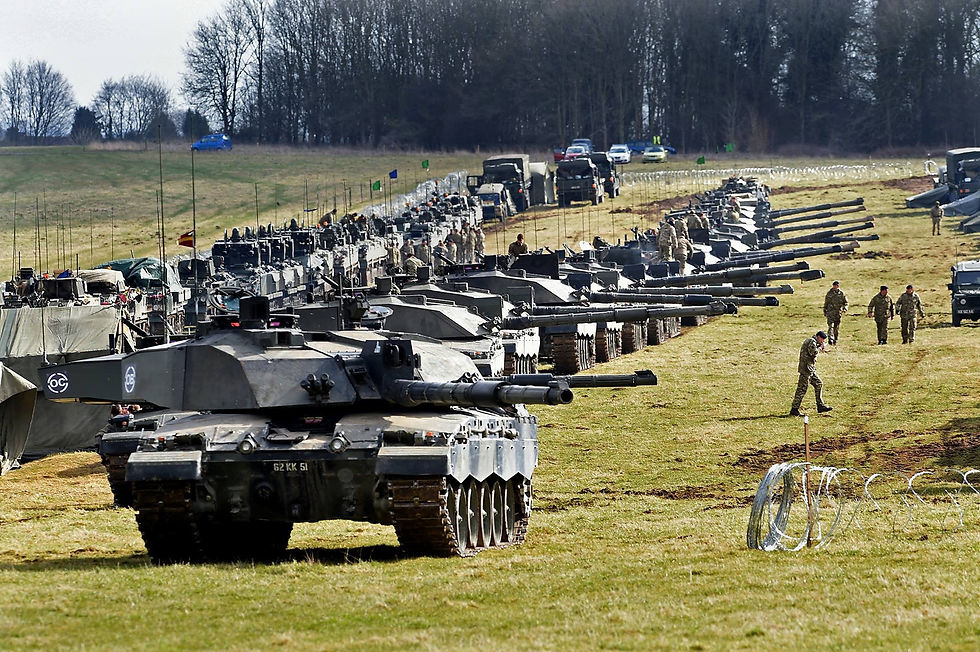
The main changes to 3rd (UK) Division were the change to BCTs, and the introduction of 1st Deep Recce Strike BCT. This leaves the "Iron Division", the armoured, tough fighting division of the Army for the past decade, with only 2 Armoured Brigades.


Not only this, but these two Armoured BCTs are structured very oddly. Both BCTs are firstly equipped with an Armoured Cavalry regiment, with Ajax, and an Armoured Regiment, to be equipped with Challenger 3. Providing the troubled Ajax programme, which also deserves its own article, is deliverable, this makes sense. However, 12th Armoured receives the Royal Wessex Yeomanry in the Armoured Reserve role, which in my opinion should be a divisional level unit, whose purpose is to remain in the UK to train new tank crews for the Armoured regiments. Then comes the second odd decision, the decision to equip 5 battalions in Boxer rather than 4. While this is welcome, especially with the strange decision to scrap the WSCP programme, it makes no sense to me to place 2 battalions in one BCT, but 3 in another! Finally, the strangest decision of them all, is the total lack in the Armoured BCTs of integrated Artillery. The army has 2 SPG regiments, namely 19th RA and 1st RHA, which would suit this role perfectly, and would mimic the US doctrine for Armoured BCTs, but instead they are placed within the 1st Deep Recce Strike BCT, where the regiments will provide the Armoured BCTs with this support anyway, but without the integration. I believe a much easier structure is easily made, which can be replicated if the Army needs to expand:
Armoured Brigade Combat Team
Armoured Cavalry Regiment
Armoured Regiment
Boxer Battalion
Boxer Battalion
SPG Regiment
Close Support Engineer Regiment
REME Battalion
RLC Regiment
RAMC Regiment
Then we come to what is, in my opinion the weirdest formation of the entire restructuring, the 1st Deep Recce Strike BCT. It seems they tried to add as many buzzwords to its title as possible, and this BCT comes at the merger of both 1st Armoured Infantry Brigade and 1st Artillery Brigade. The Brigade consists of two Armoured Cavalry Regiments, one Light Cavalry Regiment plus a Yeomanry Regiment, two Deep Fires Regiments plus one Reserve Regiment, both SPG Regiments mentioned earlier, a Reserve Field Regiment, a Target Acquisition Regiment and a Battalion of REME.
The purpose of this Brigade was to focus on the Deep Fires role, the idea being the Cavalry provides reconnaissance and the MLRS Regiments provide precise fire on enemy targets. As with a lot of ideas in this restructuring, it is good in principle, but the Brigade is missing critical elements. Firstly, it is missing infantry mass to provide support to the Cavalry units, which without this will almost certainly take large casualties in battle. Not only this, but it can hardly call itself a BCT with only a REME Battalion to its name! Again, this seems to me to be a simple fix, Place the spare battalion from the Armoured BCTs into the 1st Deep Recce Strike BCT and add some RLC, RE and RAMC units.
1st (UK) Division
The role of 1st (UK) Division as outlined in Future Soldier is to either operate on NATO's flanks or in the Middle East and further afield. For this the Division has one Light Mechanised BCT, one Light BCT, one Security Force Assistance Brigade, and a Reserve Brigade.

This structure could work, if not for it's flaws. 7th Light Mechanised BCT is a brilliant unit, capable of supporting itself and working across multiple continents, and I have no fault with it. However, 4th,11th, and 19th Brigades make little sense. I have discussed my annoyance with 11th Brigade earlier, and so will not go into further depth on it here.
On the other hand, 4th Light BCT's structure is lacking. It's combat elements are all there, but all of its support units are Reserve units. This is not a slight on Reservists, who all do a magnificent job and should be thanked for giving up their time to serve Queen and Country, but the simple fact of the matter is that reserve units cannot deploy at the same rapidity as a full-time unit, thus leading to a possible situation where 4th BCT is called upon to perform a mission, but loses crucial time due to the calling up of reservists.
Oddly, 19th Brigade suffers even worse, making it seems like an afterthought. It seems like an attempt to just dump the reserve regiments into a Brigade, relegating them from BCT status, undermining all the critical support work they have done over the years. A simple fix to these issues would be take the Yeomanry Regiment from 1st Deep Recce Strike BCT, and the Reservists units from 4th Light BCT, and make the Reserve Brigade a fully fledged BCT, whilst putting the two Yeomanry regiments currently in 19th Brigade in 7th and 4th BCTs, providing replacement and support to the regular Light Cavalry Regiments. Then, place some regular support elements into 4th Light BCT.
Global Response Force
The Best result from this restructuring without a doubt is the creation of a new "Global Response Force", by the marrying of 1st Combat Aviation BCT and a reinforced 16th Air Assault BCT. This reflects work over the last couple of years to Integrate the Apaches and Wildcats of the Army Air Corps with 16th Air Assault BCT. In conjunction with this, the reinforcement of 16th Air Assault BCT will give the BCT some real punch.
BATUS
Alongside the anger about the Ranger Regiment's Cap Badge, one of the main news headlines about Future Soldier was a suggestion that the British Army Training Unit Suffield, or BATUS, was to close, in a move for British troops to train in Germany and Oman. Although the MOD was quick to deny this, and although BATUS has not officially closed, all the armour kept there for battlegroups left months ago.

Many in Defence circles have criticised this move, but I see differently. If a conflict, especially a peer-to-peer one were to kick off, it would not be very helpful to have a good proportion of our precious tanks and IFVs in Canada. Combine this with the fact that ample facilities already exist, such as Sennelager in Germany and the UK Joint Training Area in Oman, this makes sense as a cost-cutting measure.
Conclusion
In conclusion, the Future Soldier restructuring has good intentions, but simply does not meet the needs of UK Defence currently. 3rd (UK) Division is mostly sufficient in terms of structure, but needs adjustment. 1st (UK) Division requires a large amount of restructuring to make it sufficient to be deployed as an entire Division. The Rangers are a good concept, but now need to show their worth. The Global Response Force is a very good idea, and I'm sure will work well.

Comments