
The "Warfighting Division": Can it be done?
- Assorted UK Defence Blog

- Jan 20, 2022
- 5 min read
Updated: Mar 28, 2022
1989 is an important year for the British Army. It signifies the last time a full division (3rd Armoured Division) deployed on exercise as part of Exercise White Rhino. However, under the Future Soldier restructuring, the Army aims to deploy a "full warfighting division by 2030". The question at hand is; can it be done, and if so, how?

Contents
Can we deploy the Division?
How to structure the Division
How to equip the Division
How to deploy the Division
Can we deploy the Division?
TDLR: Not at the moment. A suggested by Future Soldier, the British Army is currently unable to deploy it's main warfighting force, 3rd (UK) Division. Well, not fully anyway. In it's current formation, the Division is undeployable. This is due to several factors: Critical underfunding of the Army since the 2000s, Lack of new equipment and Old equipment breaking down or being unavailable. However, the 3rd (UK) Division has proved that it can deploy a good amount of it's forces at the moment.
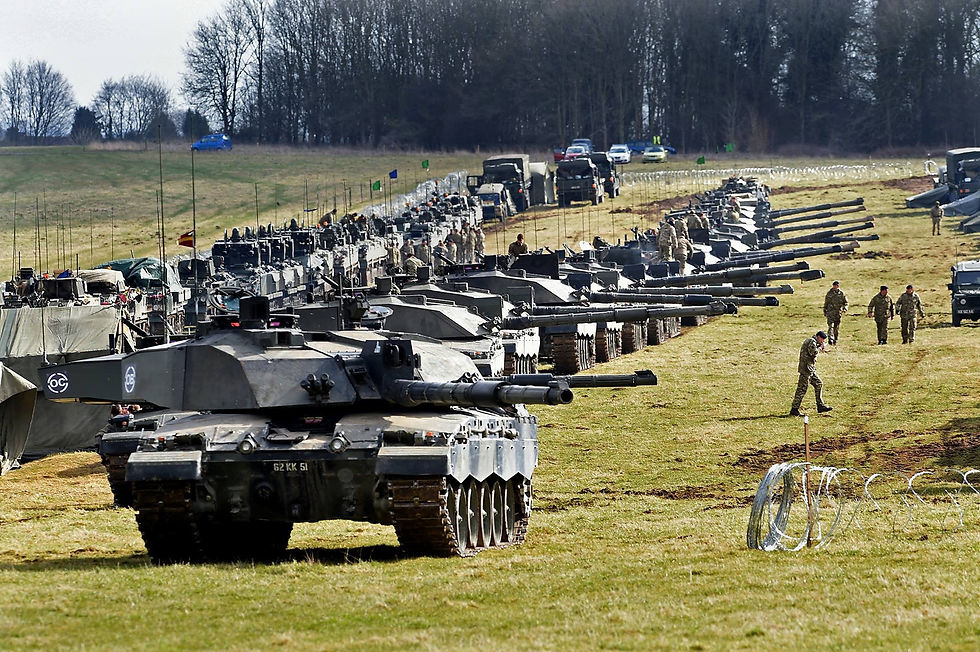
For example, the 3rd (UK) Division's HQ proves often it's ability to deploy at short notice and command units beneath it, with the Division's quick establishment of the Efp battlegroup in Estonia and subsequent reinforcement of it, shows that at least a good proportion of the Division could deploy. This shows the Division is definitely capable of deploying it's own HQ plus at least two battlegroups at this current moment. I would predict currently the Division could muster it's HQ and an Armoured Infantry Brigade, possibly a second. Obviously, this is not sufficient, as illustrated by the promise to deploy the entire Division by 2030.
How to structure the Division:
To achieve this goal on the other hand is another matter. The first hurdle the British Army must jump to achieve this aim is an almost total restructuring of the Division. This was done in Future Soldier, but the restructuring simply does not meet the demands placed upon the Division.
For this restructuring, I have gone along with the plans under Future Soldier to convert the Division's Brigades to Brigade Combat Teams (BCTs), which will allow each BCT more self-sufficiency through the inclusion of support elements within each BCT.
The Division under my proposal would be classed as a 'Penetration' Division under US doctrine. This is because the UK is unlikely to bring more than one Division to the defence of NATO, and thus if this is to be the case, it makes sense to give said Division as much 'teeth' as possible. Thus, I put forward my own proposal for a restructured 3rd (UK) Division:
XX
3rd (UK) Armoured Division
Armoured Regiment (R)
12th Armoured Brigade 20th Armoured Brigade 22nd Armoured Brigade 1st Artillery
Combat Team Combat Team Combat Team Brigade
Armoured Cavalry Armoured Cavalry Armoured Cavalry MLRS
Armoured Regiment Armoured Regiment Armoured Regiment MLRS
Armoured Infantry Armoured Infantry Armoured Infantry MLRS (R)
Mechanised Infantry Mechanised Infantry Mechanised Infantry Light Cavalry
SPG Regiment SPG Regiment SPG Regiment TA
Royal Engineers Royal Engineers Royal Engineers REME
REME REME REME RLC
RLC RLC RLC
RAMC RAMC RAMC
6th Air Defence 101st Operational Sustainment 7th Signals
Brigade Brigade Brigade
MRAD Divisional Support Logistics Comms
MRAD Divisional Support Logistics Comms
SHORAD Transport Regiment (R) Comms
SHORAD Transport Regiment (R) Comms (R)
AD(R) Supply Regiment (R)
REME
REME (R)
(Note: The use of the name 3rd (UK) Armoured Division is personal preference as I believe it better fits both the Division's composition and it's nickname as the 'Iron Division'.)
This Divisional structure forms the Division's combat elements into 3 Armoured BCTs, allowing one BCT to be on very high readiness, one BCT on medium readiness, and one BCT on low readiness in rotation, allowing increased speed in response to a crisis.
The primary principles of the restructuring are:
A focus on Deep Fires
An increase in Air Defence
An increase in Tanks and IFVs
A dramatic increase in numbers of ATGMs
The focus on Deep Fires allows the Division to deal disproportionate damage to a Division of the same size from long range, by incorporating MLRS with Recce elements to detect and then destroy primary enemy vehicles. The increase in Air Defence will allow the Division more room for maneuver, and contribute to any air battle above the Division's deployed area. The increase in Tanks and ATGMs will of course improve the Division's ability to counterattack but the most important increase is the increase in ATGMs, which will make the Division a very difficult unit to attack with conventional Armoured forces.
How to equip the Division:
As part of this restructuring, the 3rd (UK) Division must undergo an equipment upgrade programme unlike seen in the British Army for decades. This upgrade would be made across the Division, from the battle rifles of the infantry to Main Battle Tanks (MBTs).

Firstly, we must look at the equipment of the infantrymen of 3rd (UK) Division. Currently, the Division is undergoing conversion to the L85A3 Service Rifle, with around 17,900 rifles currently in the British Army's inventory, with the majority of the rifles being converted by 2030. However, I would make some changes to the Armoured Infantry Platoons of the Division. Firstly, I would re-integrate the L7A2 GPMG into Armoured sections upon the introduction of Boxer. Secondly, I would increase the anti-armour capabilities at a Platoon's disposal. Currently, the Platoon's are equipped with 6x NLAW ATGMs, which whilst useful, won't pack enough punch against a peer enemy. Thus I propose providing the Platoon HQ with a Javelin ATGM team, to increase firepower.

Secondly, we must look at the heavy armour of 3rd (UK) Division. Under current plans, the British Army aims to upgrade 148 Challenger 2s to Challenger 3 standard, but for this plan that number would have to be increased to around 180-200. Next, the new Division requires a vehicle in the Armoured Infantry (IFV) role. This would most likely fall to the Swedish CV90, as it is the best IFV on the market. As under Future Soldier, the Mechanised Infantry (MIV) role would fall to Boxer, as it makes little sense to cancel the order, and the large order of around 500 vehicles could mean replacement at least in part of the ageing FV432 fleet.

Finally, the Artillery and Air Defence assets at the Division's disposal must be considered. Under Future Soldier, the M270 MLRS systems are receiving a significant upgrade, and so little will change with them. However, the Mobile Fires Platform (MFP) programme will have to be dramatically speeded up. The primary and most likely candidate for this programme to replace AS-90 would be the K-9 Thunder, as it is the best SPG currently on the market. In terms of Air Defence, this plan doubles the number of Sky Sabre and Starstreak MRAD and SHORAD Regiments of the Royal Artillery, as any future battlefield will be won, at least partially, through control of the skies.
How to deploy the Division:
Now that we have established how the Division should be restructured and re-equipped to meet the threats of the 2030s and beyond, we must touch on how it is to be deployed. The most likely place for the Division to be deployed would be the European landmass, most likely Estonia. Obviously, there is a possibility of elements of the Division being called upon to deploy outside of Europe, which is a possibility which must be accounted for. Thus, I propose the Divisions be deployed on rotation like this; one Armoured BCT forward-deployed in Estonia, one preparing for deployment in Sennelager, and another BCT as well as the support elements based on Salisbury Plain, to allow for elements of the Division to be based closer to strategic sealift elements, for if they are required to deploy abroad.


Comments